The Rugby Paper
The culture of playing through pain has got to stop
Read articleFeatured Commentary
I help people recover from concussion and Post-Concussion Syndrome by identifying and addressing the root causes of their symptoms, not just managing them.
Personalised one-to-one support combining education, structured recovery guidance and practical strategies to help you regain confidence, rebuild your life, and move forward.
No obligation, just a chance to talk about what you're experiencing and see whether I can help.
"I've been there. I know what it's like."
Barney
"I've been there. I know what it's like."
Barney
approach
one-to-one support
recovery, not just symptom management
for real-life progress

Concussion and Post-Concussion Syndrome can turn your life upside down. The symptoms can be confusing, isolating, and often misunderstood, even by medical professionals. The Concussion Journey was created to bridge that gap. After my own battle with 20+ concussions, this platform combines lived experience, scientific research, practical recovery strategies and proven counselling/mental health theories to help people understand what's happening in their brain and body, and more importantly, what they can do about it.
Through education, structured recovery guidance, and personalised support, The Concussion Journey helps people regain confidence, rebuild their lives, and move forward beyond concussion.
The Concussion Journey portal is the private space every client gets when they start working with Barney. It turns a recovery plan into something you can follow day by day, on your phone or your laptop.
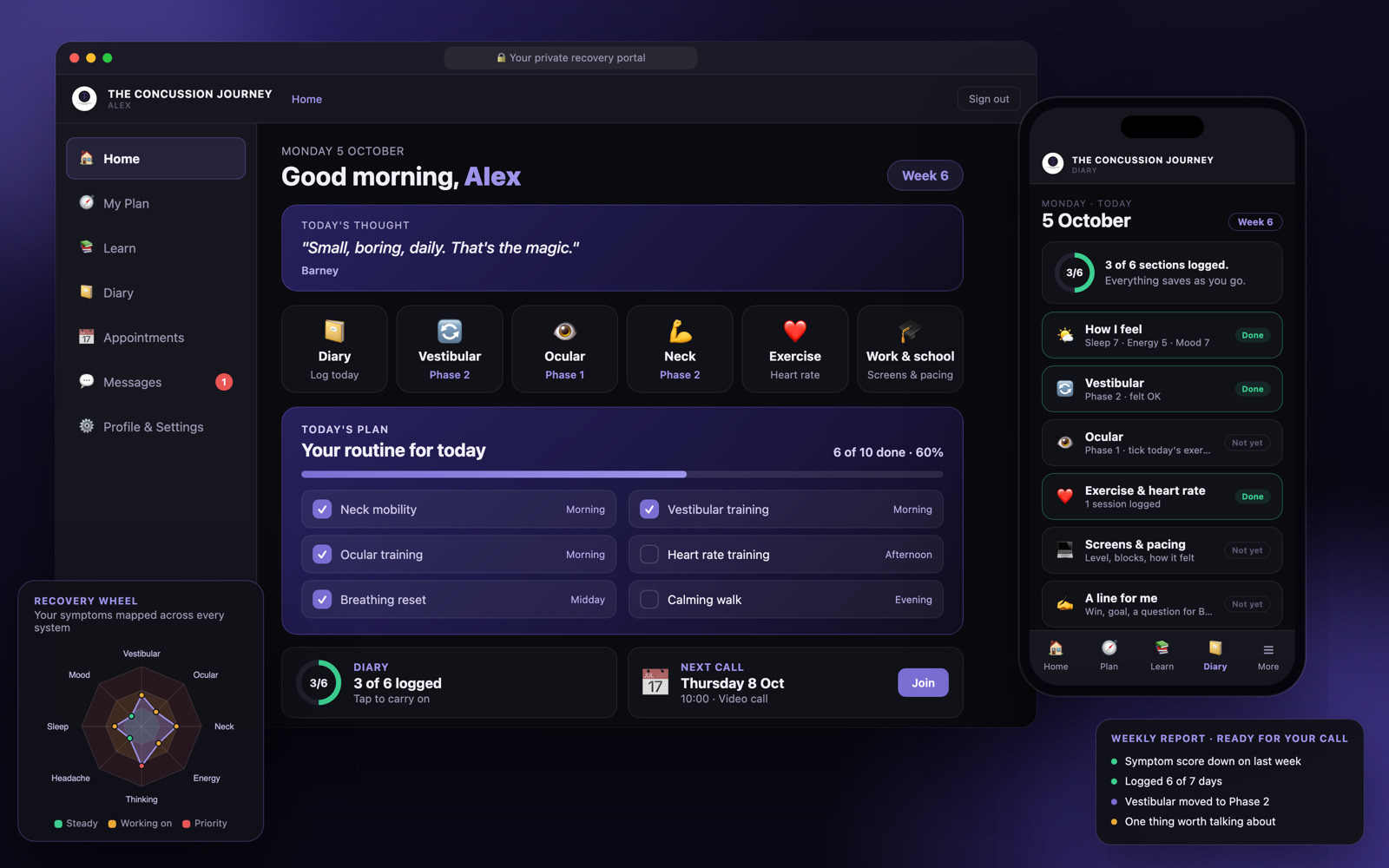
The portal supports coaching and education alongside your medical care. It is not a medical device and does not diagnose or treat any condition.
A short assessment maps your symptoms across every system (balance, eyes, neck, energy, thinking, sleep and more) into a recovery wheel, and builds a phased plan from it.
Open the portal and your day is laid out: what to do and in what order, ticked off as you go.
Step-by-step vestibular, ocular and neck exercises in clear phases, with heart-rate guided exercise and screen pacing for getting back to work or study.
Log how you feel, what you did and how it went in under a minute. Look back over the weeks and see how far you have come.
Your diary becomes a bullet-point summary for each call, so nothing gets forgotten.
Private messaging, your appointments and the notes from your calls, all in one thread.
Plain-language guides on sleep, nutrition, the nervous system and the questions clients ask most.
Invite-only access. Your data is encrypted and seen only by you and Barney.
Persistent symptoms can be confusing and overwhelming. While doctors and nurses do their best, they're often stretched thin and not always equipped with the latest concussion research. Our aim is to bridge that gap, bringing you up-to-date, forward-thinking knowledge and support you might not receive in a standard GP visit.
The right support for concussion can be very hard to find and quite an arduous process for someone struggling with symptoms. We aim to give you all the advice you need or at least point you in the right direction.
Navigating concussion recovery can be overwhelming without having to juggle a career, social life, school and everything else that goes on in life, and you cannot just give these things up. I have found through my own recovery experience, and through helping others through theirs, that a routine that allows you to recover effectively but also doesn't leave you with symptoms all day is the best approach. It is delicate and precise but well directed to make sure you are recovering as quick as your body will allow.
There are many factors that can prolong symptoms, and some of the most effective treatments are easily accessible in a gym or using at home physio/rehab techniques. We aim to share some/point in the right direction.
Learn more about what The Concussion Journey is all about and I will give a taste of my experience and what has got me to where I am today. Hopefully you will come away from the call with some free information on how to improve your symptoms, and if you are impressed enough then you will have a chance to progress to the full 121 Concussion Buddy programme.
A structured coaching programme built around the 6 Pillars of Recovery, combining expert-led rehab, nervous system regulation, movement, mindset, nutrition, and support. Personalised, science-backed, and designed to help you finally move forward, one step at a time.
From unable to hold her own head up to two job offers in one day, a day trip abroad, Wimbledon, and getting back into sport, all without a single crash in months. "If I'd started sooner, I would have had my life back much sooner."
Dizzy on every run, waking up feeling hungover with nothing to drink. Three months later, she understands why, and knows when a headache means stop versus when it means keep going.
Crying every day, couldn't work, couldn't go to uni. Three months later: full work hours, hockey training, a 3-hour bike ride, and barely thinking about her symptoms.
It took four years and a coach telling her to consider quitting before things changed. Now she's symptom-managed, thriving academically, and at peace with a life that isn't built around the sport.
Constant headaches, memory issues, unable to process what people said to her. Today: no lingering symptoms, and confident calling herself recovered.
Other specialists pushed him in directions that weren't right for his body. Three months of a genuinely tailored, trial-and-error approach later, his symptoms have improved massively.
A retired professional rugby player on nine years of vague answers, and what changed when someone who'd actually lived it finally gave him a plan.
Living in a dark room, headaches every day, no social life. Three months later: back on the bike at 150 beats per minute, back at the football stadium, and back to feeling like herself.